Portfolio trading is reshaping credit - here's how
[Music]
Shiny Das: Hello and welcome to JP Morgan's Making Sense. I'm your host, Shiny Das, from the Vida Portfolio Solutions product team at JP Morgan. And today's conversation is the one I'm specially excited about. In this episode, we are going to explore the rise of portfolio trading and the impact it has had on credit markets around the world. Joining me today are two of our portfolio traders, Gustav Vogel, we also call him Gus. He's the head of portfolio trading in Europe, Middle East, and Asia. And Marcus Imbert is the head of portfolio solutions in North America. Gus, Marcus, welcome to the show.
Gustav Vogel: Thanks. It's good to be here.
Marcus Imbert: Thanks for having me.
Shiny Das: To kick things off, let's start with the big picture. Portfolio trading has grown rapidly on both sides of the Atlantic, but there's still some key differences. Gus, Marcus, from your perspectives, what are the key differences between portfolio trading in EMEA and North America? And how do factors like market structure, local regulation, and transparency frameworks affect your day-to-day?
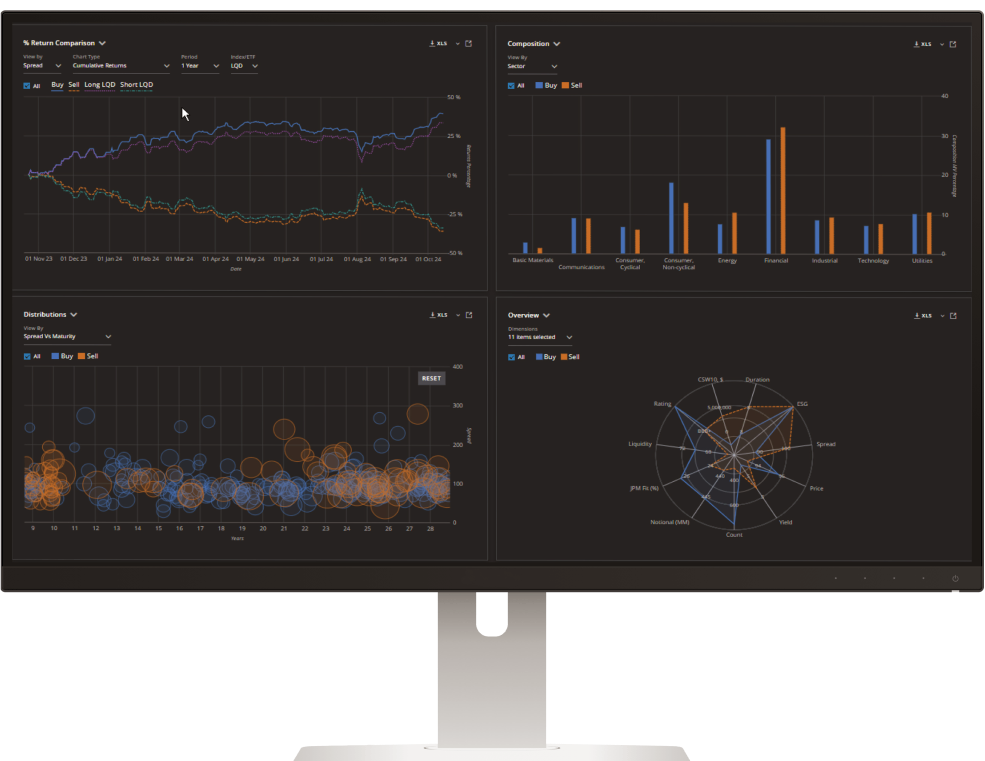
Gustav Vogel: Yeah, great question, Shiny. And what I'm actually glad you asked, so just a bit of background, while I currently sit in London with our EMEA portfolio trading business, I was originally focused on the US market, so this is something I've been learning and navigating in real time over the last year or so. So quite topical to me both professionally and, and personally. You know, from my perspective, the US and EMEA portfolio trading markets are definitely more similar than they are different, and we've absolutely noticed them beginning to converge even more in recent years, but some differences continue to stick around. And most notably, that's gonna be things like pre-trade pricing and transparency, you know, how to accurately portray pre-trade analytics to clients, how accounts leverage tools like Vida as a pre-trade screening tool, and especially, you know, all those factors in the absence of things like trace and, and the European market at the moment. Although I do wanna mention that the consolidated tapes will be implemented by the end of the year and, and both the UK and the continental regulatory regimens, so, so something, you know, important to factor in as well. But, you know, along those lines and along those differences, it's critical that we're continuing to invest in these types of tools like Vida and then the ability to give our clients the best possible trading insights in a very technical market. Another key difference that I oftentimes point to is, is the difference that ETF primary plays in hedging portfolios and EMEA versus NNA. You know, the level of precision that you're able to achieve in the ETF channel in the North American market is quite different than the level you're able to achieve in the EMEA market. And what I mean by that is that in North America, you have LTD to cover your broad market beta, and then products like VCSH, SPIB, VCLT, to cover your specific points in the curve. In the EMEA market, it's a bit more limited how tactical you can really get. So you, you've got your big liquid products like, you know, IAC or ECRP that focus on the broad IG market without allowing you to really focus on any specific point or quality bucket. Or on the curve or quality bucket rather. And then finally, I, I also think it extends to the way in which market participants are leveraging portfolio trading. So something that is especially topical at the moment, given the nearly 50% year-over-year growth and EMEA portfolio trading inquiry between 2024 and 2025. In general, the EMEA market has traditionally lagged the North American market in regards to customs and bespoke portfolios, but it's certainly a place we've seen exceptional interest in Euro GBP in recent months, and that's especially, you know, with all the volatility we see in the market today, and as folks leverage custom baskets or bespoke solutions to solve for more complex inflows or nuanced mandates. And that's especially true when we're working in, you know, either the cross currency or cross asset type space.
Marcus Imbert: I think what Gus said, it's pretty spot on. It's important to recognize the unique ways different clients are leveraging portfolio trading. Asset managers are primarily using it to effectively facilitate inflows and outflows, insurance clients leverage it for tech loss harvesting, duration management and bookier pickup, whereas hedge fund clients leverage it primarily to act quickly on relative value opportunities. As different accounts find different applicabilities of portfolio trading, it's becoming a significant part of the overall market, accounting for roughly 18% of all secondary trading and investment grade, which has been quite constant over the last couple of quarters, and 14% in high yield, which has increased from 10% over the last year. On average, we see around three billion of portfolio trading increase a day across approximately 50 trades, invested materially and technology to facilitate that type of flow. I would say in general, in North America, the conversations have shifted from why to use PT to more nuanced use cases, such as cross-asset trades, basket trades via total return swap, and other custom solutions such as multicurrency portfolio trading.
Shiny Das: That's a great point, Marcus. So focusing a bit more on the solutions piece you mentioned, this seems to be an important feature of trading in a portfolio format, and a way to leverage both your expertise and the data available to you. So what are the main themes you're seeing in the solution space, and how does the partnership with clients typically work?
Marcus Imbert: Most engagements start with the problem statement. What does a client need help with? What are the challenges they are facing? And how can we partner with them to find a solution which best fits their objective? It's really tough to generalize here as it's very client and mandate dependent. But one thing which has been very topical across asset solutions, which can include, for example, securitized products, credit, rates, and munis, all in a single portfolio trade. It's clear to us that if you want to continue to be relevant in the portfolio trading space, you need to be able to provide liquidity beyond credit only. As portfolio trading has evolved from being a tool to manage inflows and outflow within credit towards an asset allocation vehicle within fixed income. Another area of heightened client demand is the insurance solution space, where clients leverage PT to solve asset liability matching problems through modeling and better aligning cash flows, or net interest maximization proposals, where we can solve for bidirectional trade with a targeted loss budget or break even point in a proceeds neutral matter.
Shiny Das: Thanks, Marcus. Gus, what's your take on it?
Gustav Vogel: Yeah, on the EMEA side, I'd, I'd say the dynamic is largely the same. So for us, cross currencies and other solutions piece is proving very, very relevant at the moment, and this makes a ton of sense. And I know it's something we've mentioned a few times already in this conversation, but for clients with global credit mandates, cross currency portfolio trading provides a mechanism to quickly put on your risk across your entire mandate and a single transaction with the instantaneous and guaranteed execution. So, you know, from my perspective, this helps accounts understand the economics on the trade in its entirety before staying done, and it helps clients reduce their legging risk as they implement the strategy in its entirety. In my view, trading this way offers traders and PMs a ton of flexibility when managing a large portfolio, and from the GPM side, we regularly monitor the FAB index, which is, you know, the foreign attractiveness of the US bonds, and work with accounts to build custom baskets that capture the basis or capture moves in the basis and help them implement cross currency RelVal when the opportunity presents itself. So just another way that we're incorporating cross-currency trading into our day-to-day.
Shiny Das: So expanding on that a bit, one of the drivers of portfolio trading is that it allows a theoretical idea to become something you can actually trade. In terms of recent trends, we are seeing more demand around thematic baskets. So Gus, what are some of the top themes you're seeing and how are we supporting this activity?
Gustav Vogel: Yeah, absolutely. You know, one of the way that accounts are leveraging portfolio trading is as a tool to make the abstract concepts and trade ideas executable. And what I mean by that is basically, a trade might sound great in theory, but you need to be able to action it, and PT has been especially relevant on this front. Uh, one specific way that we're seeing this play out in portfolio trading is in the form of proxy baskets, where we aim to replicate the sector, rating, or maturity distribution of an ETF index, and then build that out in a liquid and transactable cash bond basket. So in my opinion, it's a really powerful tool for clients who want to replicate exposure in a scalable and cost-effective way. And as I mentioned before, this is just another place where we're seeing accounts leverage things like Vida as a pre-trade screening tool, as well as using the optimization function available within Vida to define, you know, redefine, build around executable baskets. So in addition to that, I, I think some of the other places that we're seeing growth in this space are increased interest in share versus bond portfolio trades. And what I mean by that is effective where people widgetize between ETF and cash bond risk. Some other places where we're seeing an increased interest would be in curve and sector RelVal type baskets. So one that we recently put out would be underweight cyclicals versus overweight non-cyclicals or decompression or compression baskets like, you know, a single A curve compression trade idea that, uh, we recently published off the EMEA desk. All these are ways that we can help take what might be an intangible or abstract idea and put into actual executable trading terms.
Shiny Das: Interesting that you mentioned the fungibility between bond portfolios and ETFs. Marcus, can you talk a bit about how ETFs and portfolio trading complement one another and how ETF primary trading provides additional liquidity?
Marcus Imbert: Of course. It's almost impossible to be active in PT without a strong presence in ETF primary and secondary, as these are naturally complemented products. ETFs are central to pricing diversified PTs given their liquidity and transparent risk proxies. As its core, PT is trading a diverse basket of bonds, and ETF primary is converting this diverse basket of bonds into shares or vice versa, versa, and ETF secondary is trading these shares. So the natural overlap is hard to overlook here. Similarly, you cannot view trading activity in any of these areas in isolation. Being lifted on a large block of ETF sets you up as a better buyer in cash, or being hit on a PT sets you up as a better seller in ETF. Practically, these activities go hand in hand and are linked together by ETF primary. In North America, we benefit from a broad suite of ETFs across tenants and quality for hedging and base management. And I think what also fits back in, into our earlier conversations about thematic trends we are seeing is, for example, when clients are looking to shorten ETF, while borrow costs are elevated, they lean on us to create proxy baskets of bond, bonds which track the ETF well and solve for our borrow costs being close to general collateral and can trade this basket and cash over total return swap instead of the ETF shares itself, which has been another popular portfolio solution.
Shiny Das: Marcus, that's a really helpful explanation of how ETFs and portfolio trading interact from our liquidity perspective. During periods of market volatility, how does portfolio trading help clients manage risk? And have you noticed a change in portfolio trading activity during periods like 2025's liberation day?
Marcus Imbert: During episodes like the recent tariff volatility in April last year, it [inaudible 00:11:13] with big spikes, but the share of PT of overall trading held steady in investment grade and even increased a bit in high yield. Clients value the execution certainty of portfolio trades and the timing, making it the trusted protocol, even when liquidity is a bit more challenging. I'm convinced that the ability to complete larger risk transfers in these periods of stress through portfolio trading has supported market stability in North America.
Shiny Das: Thank you, Marcus. Gus, do you think you saw the same thing in EMEA?
Gustav Vogel: Yeah, I totally agree. Um, you know, at a high level, when liquidity begins to drive in the market, clients looked at PT as a way to manage their portfolios and implement their investment mandates. And you see that NA, EMEA, everywhere. I think for clients and dealers, trading via PT during volatility provides some comfort. You know, as I mentioned earlier, there's instantaneous and guaranteed execution on the entire list, and from a dealer's perspective, you know that you're not just getting hit when you're too tight or lifted when you're too wide, and that allows us to provide better execution overall. You know, from, from my perspective, it's actually an interesting time to the point that we're just discussing. Clients may leverage a beta one basket as a way to increase market exposure, quickly hedge when markets are volatile, and just another way where we're seeing PT inquiry increase in times of increased stress, volatility, ambiguity, et cetera.
Shiny Das: Gus, that's a great point about how portfolio trading can provide certainty of execution during volatile markets. Looking ahead, Marcus, maybe starting with you, what are some of the trends or developments you're most excited about, and what do you think might be the next big thing in portfolio trading?
Marcus Imbert: My view is that investment grade and high yield portfolio flow will become increasingly systematic, eventually coming to a stage of auto reponts, responses, and seek to trade for generic risk transfers. With portfolio trading share, total secondary trading continuing to climb, both in North America and in EMEA. At the same time, clients will lean on us for more complex and unique trading activity, such as cross-asset solutions, trading via total return swap, or bespoke structures, and for advisory around larger risk transfers.
Shiny Das: Gus, what's your view?
Gustav Vogel: For me, I think it's gonna be continued client adoption of tools like Vida and more dealers aiming to put data and analytics in, in clients' hands more efficiently, more effectively, a sort of democratization, if you will, of, of the data behind fixed income. In my views that this, in addition to greater transparency in the EMEA market, you know, following the, uh, the introduction to consolidated tape that I mentioned earlier, it's gonna lead to improved price discovery and can guide execution decisions to go via PT, RFQ, ETF, whatever's most efficient for clients, whatever's most efficient for our end investors. And I think we'll see folks engage us on the electronic front and leverage our tools for portfolio construction, market monitoring, performance tracking, and as Marcus mentioned, engage with us more directly for more nuanced, esoteric type mandates where we can add a lot of value.
Shiny Das: Gus, Marcus, thank you both for sharing your insights today. It has been really interesting hearing your perspectives on everything from ETFs to custom portfolio construction. This has been a great discussion.
Gustav Vogel: Thanks, Shiny. Yeah, it's been a pleasure.
Marcus Imbert: Agreed. It has been great speaking with you.
Shiny Das: And to our listeners, thank you for tuning in to this episode of Making Sense. For those who would like to know more about portfolio trading or VW21, please contact your JP Morgan representative. Thank you for listening.
Voiceover: Thanks for listening to JP Morgan's Making Sense. If you've enjoyed this conversation, share your feedback by leaving a comment or review wherever you listen to podcasts, and be sure to follow our channel so you don't miss an episode. This podcast is intended for institutional clients only. The views expressed in this podcast may not necessarily reflect the views of J.P. Morgan Chase & Co, and its affiliates, together J.P. Morgan, and do not constitute research or recommendation advice or an offer or a solicitation to buy or sell any security or financial instrument. Referenced products and services in this podcast may not be suitable for you, and may not be available in all jurisdictions. J.P. Morgan may make markets and trade as principal in securities and other asset classes and financial products that may have been discussed. For additional disclaimers and regulatory disclosures, please visit www.jpmorgan.com/disclosures. Copyright 2026 JPMorgan Chase & Company. All rights reserved.
[End of episode]
Disclaimer:
The views expressed in this podcast may not necessarily reflect the views of J.P. Morgan Chase & Co and its affiliates (together “J.P. Morgan”), they are not the product of J.P. Morgan’s Research Department and do not constitute a recommendation, advice, or an offer or a solicitation to buy or sell any security or financial instrument. This podcast is intended for institutional and professional investors only and is not intended for retail investor use, it is provided for information purposes only. Referenced products and services in this podcast may not be suitable for you and may not be available in all jurisdictions. J.P. Morgan may make markets and trade as principal in securities and other asset classes and financial products that may have been discussed. For additional disclaimers and regulatory disclosures, please visit: www.jpmorgan.com/disclosures/salesandtradingdisclaimer. For the avoidance of doubt, opinions expressed by any external speakers are the personal views of those speakers and do not represent the views of J.P. Morgan.