Long term
Partner with the world’s leading private credit providers over the long-term and leverage our fortress balance sheet.
Asset-led
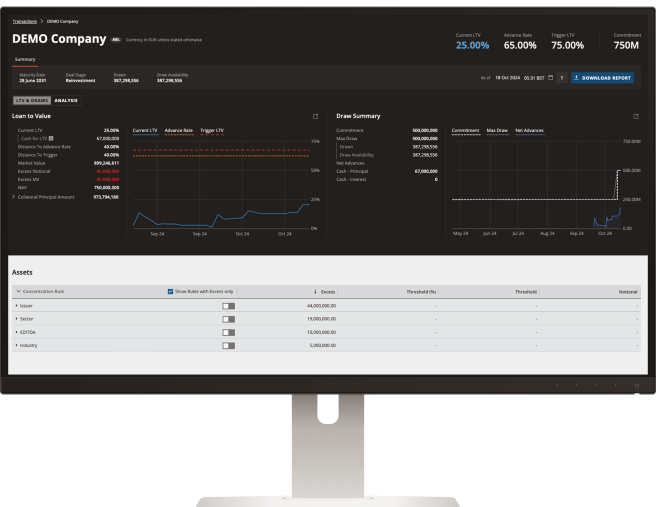
We track and mark assets on a continuous basis to maximize our clients’ borrowing capacity.
Easy to access data
Providing you with market-leading insights into portfolio-level data in an interactive format.
How are investors navigating tighter credit spreads and a surge in loan trading activity? In this episode, Brian LaRocca, head of Vida Portfolio Solutions (Americas), and Lou Cerrotta, head of Liquid Credit Financing, unpack the latest trends in loan and bond total return swaps (TRS), new opportunities in asset-based lending and the impact of regulatory changes. Plus, discover how J.P. Morgan’s innovative platforms are helping clients stay ahead of the curve in 2026.
What’s the outlook for credit financing in 2026?
[Music]
Brian LaRocca: Welcome to J.P. Morgan's Making Sense. My name is Brian LaRocca. I'm the head of our Vida Portfolio Solutions team in North America here at J.P. Morgan. Joining me today is Lou Cerrotta, who's our head of liquid credit financing globally. And we're here to discuss the credit financing outlook for the year ahead. Welcome, Lou.
Lou Cerrotta: Thanks, Brian. It's great to be here. I have to ask, what is Vida Portfolio Solutions?
Brian LaRocca: So Vida's a, a suite of cross-asset applications used by our clients in the entire investment lifecycle. That's from pre-trade to post-trade. Think of portfolio construction, management of that portfolio, any ongoing, monitoring and visualization, and of course, any reporting at the end. So I need to ask you then, what exactly is liquid credit financing globally?
Lou Cerrotta: So, Brian, my liquid credit financing team, or LCF as we like to call it, focuses on the financing and leverage aspects of liquid credit assets. That's predominantly price-transparent and publicly-traded loans and bonds, but can include other asset classes also with price transparency. The format is either through total return swaps or ABLs, which are asset-based lending structures.
Brian LaRocca: Okay. So in a seat like that, I'm sure you see a bunch of varied investment strategies. Specifically, I should mention you are the top provider of Loan TRS financing on the street. So what trends summarize the activity you sell in 2025 in both loan trading and in financing?
Lou Cerrotta: Well, Brian, we were really busy in 2025 as there was a huge demand for Loan TRS product, specifically for two reasons. First, credit spreads continue to tighten and clients increase their leverage usage to meet return hurdles. As you're probably aware, loans are in securities, so our various clients were not able to get the necessary leverage through typical financing options like prime brokerage, margin lending, or a repo. So instead, clients turn to synthetic Loan TRS exposure to meet their leverage returns. Second, overall trading volumes in the loan market were up over 20% from the prior year. Clients sought to manage this operational onslaught by trading via swap to both access the market and benefit from J.P. Morgan's operational expertise and efficiency. In essence, we were doing the operational work for them.
Brian LaRocca: I presume the vast majority of the financing you're providing are on par names, but there's concern that when trading in the distressed part of the market, clients may become ensnared in a messy distressed situation. So top of mind, of course, are liability management exercises, or LMEs. These are financial maneuvers sponsors or borrowers deploy to reduce their debt burden, and this often comes at the expense of other debt investors. So surprisingly, in 2025, we saw significantly fewer of these. Do you think this pertains to a less contentious restructuring process going forward?
Lou Cerrotta: Well, Brian, I agree with you that the number of distress exchanges and LMEs decreased by about half from the prior year. The main driver for less activity here was better than expected economic growth and more accommodative Fed policy. 2024 was also an outlier, producing two times the amount of LMEs and distress exchanges in the prior year, so this is probably more of a return to normal. As you're aware, courts are currently examining some of the tactics being used, but I think LMEs are here to stay. Overall, investors have built up their distress resiliency and they're better equipped to handle these types of situations.
Brian LaRocca: Okay. So on the LME front, a reversion to the mean, but we think that clients are more prepared for them. Let's look at the year ahead. What should clients be expecting in the loan market in 2026?
Lou Cerrotta: So specific to the loan market, the analytics are predicting a sizable increase in both gross and net supply. We're seeing a sign of more LBO activity as rates and spreads compress, and this allows for more deals to come to fruition. We have a great recent example, the EA Sports LBO, which is a sign of just how large deals are now in play in this market. There's also a growing wall of B- and Triple C rated issuers. This is definitely going to present some opportunities for clients to pick their spots. Overall, with the backdrop of new supply and topical refinancings, I think clients are going to see increasing opportunities to pick their spots, and we will have opportunities to provide synthetic LTS financing to clients while continuing that focus on operational lease.
Brian LaRocca: So we're expecting both more LBOs and an increase in total supply along with some situational opportunities at the lower end of the market. How can clients use a product like Loan TRS to take advantage of them?
Lou Cerrotta: Well, Brian, Loan TRS is an over-the-counter derivative or OTC derivative used by a variety of entities from hedge funds, private equity funds, BDCs, and other credit funds. It allows a user to obtain a synthetic long return on bank debt to replicate various strategies. This can include anything from an attempt to maximize leverage to achieve a strong carry trade. We see a lot of this done on a higher quality portfolio of par first lien loans, risk arb names, or even yield to call opportunities. Second, we see a lot of lighter leverage opportunities on special situations in the market, cap structure arbitrage, or other topical names. Finally, we provide marginal leverage on distress situations. Here, Loan TRS is usually used as a means of loan market access and more about achieving operational efficiency. I'm sure I could come up with a whole bunch of other use cases. A setup is especially easy for a client who already has an ISDA in place with J.P. Morgan.
Brian LaRocca: Your point is that Loan TRS is the go-to tool for clients looking for flexible leverage in this single name exposure. I know in recent years, we've been building up our portfolio financing business. How are clients using this strategy?
Lou Cerrotta: So, Brian, this is referring to our ABL, product, which fits in nicely next to Loan TRS, as it allows our clients to lock in a financing arrangement, but purchase and manage a portfolio of assets opportunistically as credit conditions might change. We've seen a lot of inquiry from clients who are seeking to manage this risk, but for whom a more stringent CLO structure really isn't going to be applicable. Clients also value the time and effort we put in for the entire experience, such as viewing their facility in Vida Finance and Connect.
Brian LaRocca: Okay, so this is exactly what Vida Financing Connect was built for. You detail all the components and then the borrowing base of an actively managed ABL. Clients can see position reporting and valuations, as well as a comprehensive visualization of their borrowing capacity. Workflow functionality, so think here cash management, collateral acceptance, that's all managed within the tool, allowing for a streamlined operational experience. Now, you're also the head of our global TRS business. Are there themes that we're discussing on the loan side that would be applicable on the security side?
Lou Cerrotta: They sure are, Brian, maybe even more so. For bond TRS, there's an ability to provide clients both long and short exposure. It really comes in two distinct formats. The first is very similar to our loan TRS product. We offer single name financing on corporate bonds. It's an alternative to repo, prime financing, or other leveraged alternatives in the market where clients can achieve more competitive economics, especially when we have an X on the other side. Probably the larger the opportunity set today, though, is the ability for client to express a view or theme via swap on a customized portfolio of bonds that they or J.P. Morgan can choose. This goes hand in hand with the emergence of portfolio trading, especially in the high-grade market, with about 15% of the volume now traded via portfolio trades rather than single name QSIP by QSIP transactions. As clients are looking to seamlessly finance a portfolio, our bond TRS's product is becoming more in demand. Working in partnership with our portfolio trading desk, we take a holistic view on a potential transaction and put together a portfolio, trading and swap financing package that's both efficient and competitive. We often refer to this as just the initial stage of the equification of the corporate bond market.
Brian LaRocca: Credit is always looking towards the equity markets to gauge what the future will look like. It's been fascinating to watch the evolution that, that's occurred there, so what lessons do you think bond investors can glean from what we've already seen develop in equity markets?
Lou Cerrotta: So if you look closely at the emergence of synthetic exposure in the equity space, there are really two key developments, which we should note. The first is the creation of tradable thematic baskets, and the second is dealers' ability to optimize their hedging strategy to offer more competitive pricing. Our colleagues in our equity franchise have done a great job of curating baskets that have focused on two-way liquidity, and they use that decreased transaction cost to offer compelling financing terms. Although it's at its earliest stages, we're trying to use that same playbook in the corporate bond market and use coordinated flow to reduce friction costs. I think that'll allow us to provide more efficient bid offer and financing alternatives to clients.
Brian LaRocca: That's exactly why we've added the market monitor into our Vida Beta One platform. It shows the thematic baskets in the fixed income market, so clients can see real-time pricing and iterate on each basket to tailor to their investment needs. This is in addition to the wealth of other services we're providing Beta One, so analytical data, optimization capabilities. Of course, if you do transact in bond TRS form, we give you all the post-trade reporting capabilities as well. It's for this reason that Vida Beta One recently won the American Financial Technology Award's most cutting-edge IT initiative. Any clients interested in learning more or getting access to Vida should reach out to their J.P. Morgan sales representatives. Lou, I wanted to close with your thoughts on some of the recent regulatory changes we've seen over the past year. So most notably has been the recalibration of the so-called enhanced supplementary leverage ratio, or ESLR. What material changes should financing clients be aware of?
Lou Cerrotta: Well, Brian, embedded in that recalibration are changes to the calculation for TLAC, or total loss-absorbing capital, or LTD, long-term debt. Estimates are varying across the street, but we think this should lead to a meaningful release of capital and banks balance sheets starting early this year. There's a lot going on in the regulatory docket, as I'm sure you're aware, and it's a space that we're actively monitoring.
Brian LaRocca: Sounds like a good topic for a future chat. Thank you for your time today. And thank you to our listeners for tuning into another episode of J.P. Morgan's Making Sense. We hope you join us again next time.
Lou Cerrotta: Thank you, Brian.
[Music]
Voiceover: This communication is provided for information purposes only. Please visit www.jpmm.com/disclosures for important disclosures.
Copyright 2026, JPMorgan Chase & Co. All rights reserved.
[End of episode]
Disclaimer:
The views expressed in this podcast may not necessarily reflect the views of J.P. Morgan Chase & Co and its affiliates (together “J.P. Morgan”), they are not the product of J.P. Morgan’s Research Department and do not constitute a recommendation, advice, or an offer or a solicitation to buy or sell any security or financial instrument. This podcast is intended for institutional and professional investors only and is not intended for retail investor use, it is provided for information purposes only. Referenced products and services in this podcast may not be suitable for you and may not be available in all jurisdictions. J.P. Morgan may make markets and trade as principal in securities and other asset classes and financial products that may have been discussed. For additional disclaimers and regulatory disclosures, please visit: www.jpmorgan.com/disclosures/salesandtradingdisclaimer. For the avoidance of doubt, opinions expressed by any external speakers are the personal views of those speakers and do not represent the views of J.P. Morgan.

How has structured financing moved into the private market mainstream? In this episode of Making Sense, Shiny Das from the Vida Portfolio Solutions product team sits down with John Neubauer, Global Head of Structured Equities Financing at J.P. Morgan, to examine the forces reshaping demand for structured financing as investors seek liquidity, flexibility and transparency. Together they look at how subscription lines have expanded, why NAV lending is becoming a core tool, and what aspects of structured financing are primed for further evolution.
[Music]
Shiny Das: As private funds continue to proliferate, structured financing is playing an increasingly important role, particularly as managers look to bridge timing mismatches, optimize returns, and create greater flexibility around capital deployment. Welcome to J.P. Morgan's Making Sense. In this episode, we are going to explore how solutions like subscription lines, NAV lending, and increasingly sophisticated financing structures are helping clients meet their evolving liquidity and leverage needs and how these solutions are evolving alongside the broader private markets ecosystem. I'm your host, Shiny Das, part of the Vida Portfolio Solutions product team at J.P. Morgan, where we focus on digital solutions supporting financing and portfolio workflows for our clients. And I'm joined today by John Neubauer. He's the global head of structured equities financing at J.P. Morgan. John, thank you for joining us today.
John Neubauer: Thank you, Shiny. Pleasure to be here.
Shiny Das: Before we go into some of the specific financing solutions, let's zoom out a bit. Over the last few years, we have seen higher for longer rates, a slower exit environment, and much greater focus on liquidity and capital flexibility across private markets. John, what do you see as the biggest forces reshaping demand for structured financing today?
John Neubauer: Look, I think you said it right, Shiny. I think higher rates, slower pace of exits in terms of portfolio companies held within private portfolios have really made the focus of the last few years, one that's been on liquidity, as opposed to maybe prior to this structured fund financing was probably as much or more about return enhancement. The prevailing use case now, at least on the manager or the GP side is finding and accessing sources of liquidity, usually to support new investments and new activity, but also potentially to fund distributions. On the investor side, the liquidity need is probably a bit less acute, but it's still there because they're kind of one step removed from the pace of distributions on the manager side. So on the investor side, we continue to see investors using these tools to manage short-term working capital needs, and to do things like allow for cash to be recycled to rebalance their portfolios.
Shiny Das: Maybe let's make that more tangible by looking at some of the financing solutions in practice. So starting with subscription lines, they have been a core part of fund finance for a long time, but the conversation around them feels more nuanced now. So John, how has the market evolved over the last few years?
John Neubauer: I mean, subscription lines have been around for a long, long time. They've been a product that's probably been used for 20 years within the fund world. The historic use case for subscription lines, really was as a working capital management tool. It allowed GPs to more efficiently manage their funds by satisfying cash needs for investments and for fees without needing to call capital at each point from investors or LPs. So these lines were typically used over short time periods and then repaid. Over the last few years, these cases really shifted a bit. Subscription lines, or loans backed by investor capital commitments, are being used as longer term funding sources. Sometimes we see this with commingled funds, but we probably see it more with specialized investment vehicles, which have really proliferated over the last three or four years as well. These include continuation vehicles, separately managed accounts or co-investment vehicles. So using subscription lines in these sort of new vehicle classes, can help solve a bunch of things. It can help solve for both liquidity and target returns in a cost-efficient way. It can also be used to bridge investments with future funding rounds or future fund closings.
Shiny Das: That's really interesting. And while subscription lines remain a core part of the market, we have also seen significant growth in NAV lending over the last few years. For listeners who may be less familiar with the space can you explain what NAV lending is and why we are seeing increased adoption today?
John Neubauer: Sure. So let me start with what NAV lending is. So NAV lending, or loans against the Net Asset Value, or NAV, of a fund are effectively loans that are backed by or supported by the value of the private equity funds equity stakes in the various portfolio companies. So it's effectively the value of the fund. And historically, funds would borrow at the very top in subscription line form based on the value of the investor's capital commitments to the fund and/or they would borrow at the very bottom at the balance sheets or on the balance sheets of the portfolio companies they invested in. But what they typically didn't do is borrow in the middle. And it's in the middle where the funds effectively have a lot of unlocked or unrealized lending value that comes in the form of the equity investments or the equity that they hold in the various portfolio companies. Now private equity investing is an extremely competitive space and financing has always been kind of a core part of that space. It's always been an important part of the manager's tool set. Not unlocking this value, you might say has been a competitive miss for some managers and in some strategies. And so NAV loans and the development of NAV loans, which allowed managers to effectively borrow against this previously unlocked value in the form of the equity value in their portfolio companies, have become a critical tool. And as they become more mainstream, and more cost-efficient, managers have been able to use them in ways that complement both what they're doing at the subscription line level and what they're doing at the asset level. So, you know, in a competitive space like private equity, managers need to use every tool available to stay kind of ahead of the pack. This isn't going to change, so I expect NAV loans to continue to grow and to be used more prevalently.
Shiny Das: That makes sense, especially given how much liquidity needs and investment strategies have evolved across private markets. We're also seeing financing needs become more sophisticated as investment strategies evolve. How is that changing the way hedge funds and multi-strategy managers approach financing today?
John Neubauer: So there are actually a lot of parallels between what's happening in the structured lending space within private equity and what's happening in hedge funds. First, many hedge funds are now raising capital in ways similar to the way private equity managers raising capital. By that I mean they're raising capital in the form of capital commitments rather than in vehicles that are funded on day one. So this allows hedge fund managers to access the subscription lending space in the same way private equity has and they've really begun to use these vehicles as creatively as the private equity managers have. There are also a number of funds, particularly the larger multi-strategy shops that are putting financing at the fund level, similar to the way PE funds use now financing. This financing would sit behind the shorter term financing that they have from prime brokers or from derivative counterparties at the position level and it can be used to better match the maturity of their investments with the financing that they have against them, and it can also be used to finance assets that typically can't be financed either in derivative form or through prime brokers. So, I see a lot of parallels between what's happened in the private equity space in terms of financing innovation and what hedge funds are doing and it makes sense because there's also a lot of cross-over between what hedge funds are doing at the underlying investment level and what private equity firms are doing. So it sort of makes sense that the financing developments would mirror that.
Shiny Das: Thank you, John. That was a very interesting perspective on how there are parallels between how the hedge funds and the private equity managers are using these financing solutions. So as these structures become more sophisticated, how do you balance flexibility for clients with a very strong risk discipline?
John Neubauer: Yeah. So look, one of the many things structured fund financing products have in common is they try to unlock value across the fund complex, from the investor capital commitments, to the NAV, to credit support from entities like the GP or the management company. Underwriting and risk managing these products, therefore requires a sort of comprehensive, complete understanding of the way each of these underlying sources of credit support function, and their underlying risks and then monitoring them through time. We've developed and are continuing to develop a suite of tools like Financing Connect to help us track both investor bases and assets over time and across funds. This allows us to better understand where we have concentrations both within a given fund complex and across transactions of a similar type. These tools like Financing Connect also allow clients to, in addition to providing us information that we can ultimately aggregate and use to risk manage, they allow clients to execute transactions in a much more real-time way, track the progress of those transactions, whether it's a drawdown against a credit line, a repayment of a credit line, or compliance with the various covenants, and sort of borrowing base metrics that we have within these transactions.
Shiny Das: That's interesting because increasingly clients expect not just financing itself, but also ongoing transparency and access to information around those facilities. It becomes much more of an ongoing portfolio management experience for the client, as you said, John, rather than simply a transaction. So looking ahead, what areas of structured financing do you think are likely to evolve most over the next few years?
John Neubauer: Look, I think we're likely to see a greater acceptance of fund level structures and a greater fungibility across what were fund level structured financing transactions and the more traditional asset level financing that managers have always used. I think, the world kind of thinks of those slightly as two different things, but as these fund level financings, whether they be NAV financings or they would be hybrid financings or subscription loans, as they get more generally used, more accepted and more cost-efficient, managers will develop more comprehensive strategies for managing their borrowings and their financings across all of the various levels, whether it's the subscription line at the top, the NAV loan in the middle or the balance sheet portfolio company financings at the bottom, and they'll use them to compliment one another and they use them to sort of optimize their outcome for investors.
Shiny Das: And if you had to pick one market signal that tells you where the space is heading, whether that's exits, liquidity conditions, lender appetite or secondary activity, what would you watch most closely?
John Neubauer: So I think the biggest indicator of the development and the evolution of these products is just going to be the growth of the space overall. I think these products are now part of the toolkit. They've proven themselves to be valuable and effective, not only in the market we're in, which is one that's sort of prioritizing liquidity maybe over return enhancement, but the use case will extend across, I think, all market cycles. So I think the biggest determinant of how these things grow is just going to be the overall wallet size or the overall market size of private equity and private funds in general. And based on the last 15 to 20 years, I don't see that retreating. I see it continuing to grow. So, you know, I think this is a space that probably has become somewhat mainstream, but certainly will be more mainstream going forward.
Shiny Das: John, really appreciate you taking the time to speak with us today. It's been fascinating hearing how the financing solutions are evolving alongside the broader private markets ecosystem, and how flexibility, liquidity, and transparency are becoming increasingly important across the market. For those who are interested in learning more about Financing Connect, please see the link in the description below. And thank you again for joining us and thank you to our listeners for tuning in.
John Neubauer: Thank you, Shiny.
[Music]
Voiceover: Thanks for listening to J.P. Morgan's Making Sense. If you've enjoyed this conversation, share your feedback by leaving a comment or review wherever you listen to podcasts. And be sure to follow our channel so you don't miss an episode! This communication is provided for information purposes only. Please visit www.jpmorgan.com/disclosures for important disclosures. Copyright 2026, JPMorganChase & Co. All rights reserved.
[End of episode]
Available on the J.P. Morgan Markets Platform.
The complete markets platform. Get around-the-clock access to an advanced portfolio of digitized services, designed to put you in control.
© 2026 JPMorgan Chase & Co. All rights reserved.